UX: Tom van Wijland, Ece Günesen
ID: Isabelle Olsson, Julius Bahl
UX: Tom van Wijland, Ece Günesen
ID: Isabelle Olsson, Julius Bahl
from Above
Haptic explorations and experience prototypes.


Safer commutes for cyclists through awareness beyond the visual field.
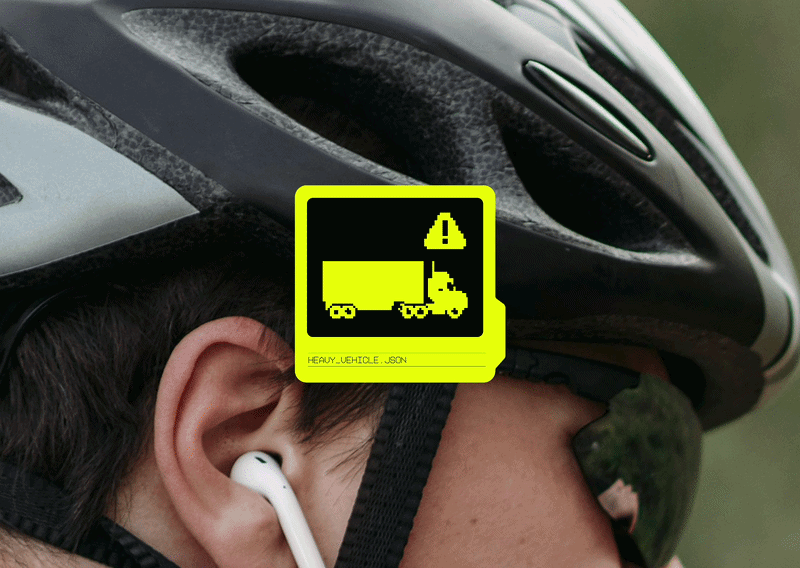
With growing efforts to expand Cooperative Intelligent Transport Systems (C-ITS) to all road users, cyclists represent a critical opportunity space. Designing human–machine interfaces for cyclists remains an open challenge, as riders must keep their visual attention on the road.

Overview
Cyclists' vulnerability in traffic has prompted experiments like Schwung, which uses connected infrastructure to provide real-time information from a perspective beyond the rider’s own, a view "from above".
Here, I explore another potential modality for communicaton that aligns with the embodied awareness of cycling: haptics.


Anatomy
Placing haptic actuators in different locations around the body and skull changes how vibrations are felt. Bone density and surrounding tissue affect how feedback travels through the body, sometimes muting the signal entirely, and other times making it feel sharp or uncomfortable. Mounting actuators on the outside of a helmet caused the structure to absorb most of the vibration before it reached the wearer. These experiments helped explore how much anatomy and material interfaces shape the quality of haptic feedback.
There is also the issue of haptic priming: the body often needs subtle preliminary vibrations to “tune in” before it can clearly perceive the intended tactile signal.

Semantics
I explored the idea of a haptic language, experimenting with how different vibration patterns might communicate simple meanings like danger, left or right, or yes and no, and if we can reliably map meaning onto these tactile signals.

Please activate sound from the right corner of the video ↑
Format
I created small, battery-powered, cordless haptic sketches that can be held, carried, and shared with colleagues to test and discuss specific patterns in person. Where digital communication is necessary—and we don’t always get to test haptics face-to-face—I experimented with video and animation formats that pair the sound file with motion graphics to convey the rhythm, direction, and intensity of each vibration.


Haptics is an esoteric medium. It is felt rather than seen, which makes it really difficult to communicate or document through digital formats.
Process
Everyday objects used to communicate their status and affordances directly, which was both joyful and easier on the mind, what you see was what you got. Pressing jelly keys or texting quickly felt different from dialing a rotary phone, which demanded mindfulness and presence. These interactions carried a sense of tactility and attentiveness that’s often missing in today’s digital interfaces.

These sketches explored ways to bring meaningful resistance and tactility back to otherwise smooth objects. Can this loss of physical friction be reclaimed through haptics?
Weekly reflection
A weekly recap in the form of an audio-visual experience is compiled through all the saved recordings. By turning moments into a more fluid medium through sound, things become less easily quantified and more open for humane interpretation and reflection.
The composition can be synchronized with diverse data sources at the user's discretion.
Project credits
2025 | Duration: 4 months
Individual work for Above.
Any client work under NDA is omitted.